
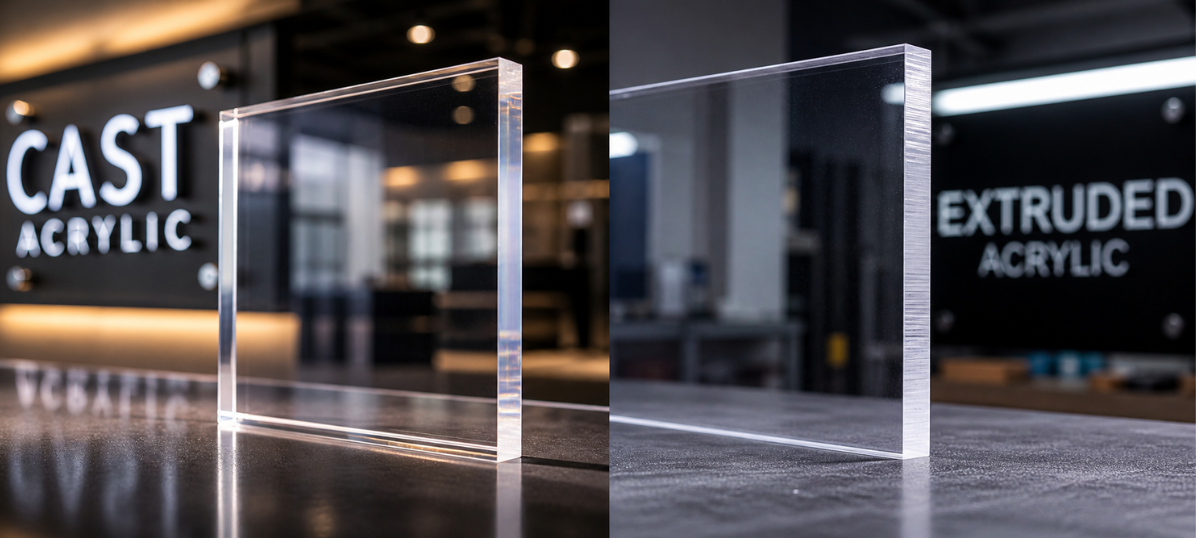
Cast acrylic is produced by pouring liquid acrylic into a mold and allowing it to harden. The result is a sheet that is more durable and offers high optical clarity. It is also resistant to chemicals and scratches.
Due to its manufacturing process, cast acrylic is ideal for detailed applications such as engraving, laser cutting, and custom signage design. It is also better suited for outdoor use, making it a superior choice for long-term signage.
The cast acrylic is produced by pouring liquid acrylic into a cast and letting it dry. The end result is a sheet that is more durable and has a high level of clarity. It has good clarity and is resistant to chemicals and scratches.
The cast acrylic, due to its manufacturing process, is suitable for detailed applications like engraving, laser cutting, and designing of custom signage. It is also more suitable for outdoor conditions and therefore is a superior choice when it comes to long-term signage.
Extruded acrylic is manufactured by forcing melted acrylic through a machine to form sheets. This process is faster and more cost-effective, making extruded acrylic more affordable.
It is easier to cut and shape and has a smoother surface. However, it is softer than cast acrylic and more prone to scratches. It is best suited for simple signage, especially when budget is a key consideration.
1. Strength and Durability
Cast acrylic is stronger, more impact-resistant, and more resistant to chemicals. Extruded acrylic, being softer, may have lower durability.
2. Clarity and Finish
Cast acrylic offers superior optical clarity and a higher-quality finish. Extruded acrylic remains transparent but may not provide the same premium appearance.
3. Workability
Cast acrylic is more suitable for laser cutting, engraving, and polishing. While extruded acrylic is easier to cut, it may melt slightly during the process, which can affect precision.
4. Cost
Extruded acrylic is more affordable and ideal for large projects with budget constraints. Cast acrylic is relatively more expensive but offers higher quality.
5. Thickness Consistency
Extruded acrylic has more uniform thickness, while cast acrylic may have slight variations due to its manufacturing process.
Being aware of these differences helps signage professionals make informed decisions and avoid unnecessary costs or performance issues.
The choice depends on your project requirements. For high-quality, detailed, and long-lasting signage, cast acrylic is the better option. On the other hand, for cost-effective projects with simple designs, extruded acrylic can be a practical choice.
These two kinds of acrylic find their applications in signage. The trick is to have the material, the environment, and the budget for the project. This guarantees improved performance and durability of signage.
To help businesses make wise choices regarding the choice of materials and their use, Khanna Plastics provides valuable advice and knowledge in the field of acrylics to help you select the appropriate solutions.